Catching PDF Errors at Upload: Fireside Chat on Preflight Automation with Davy Verstaen

Posted on

Key Takeaways

  • Enfocus Switch customers start with automating preflight as the foundation, then expand to eliminate repetitive tasks – the Infigo-Enfocus integration is now Infigo’s most purchased module, automatically flowing order data into Switch without manual touchpoints
  • AI is being deployed in practical print applications today: transforming varied order data structures into JSON for MIS systems, and translating technical preflight reports into customer-friendly explanations across seven languages
  • Automation solves real capacity constraints – PSPs processing 25-30 jobs daily hit scaling limits when relying on manual prepress work, but automation frees operators to focus on profitable tasks rather than repetitive processing
  • ROI on automation occurs within 4-6 months, with customers typically gaining 50% of their time back after 3-4 months by automating small, tedious, repetitive tasks that save 1-2 hours daily
  • The biggest misconception is that automation “fixes everything” after software purchase – success requires investing time to set up workflows, identify what to automate first, and build automation incrementally for fast ROI
  • Switch’s flexibility enables creative integrations beyond standard workflows – from connecting reward point systems and financial management to color-coded status lights and multi-channel customer communication including WhatsApp
Meeting Davy Verstaen at Printing United 2025

We caught up with Davy Verstaen at Printing United 2025 for a conversation about PDF preflight automation, AI in print workflows, and the Infigo-Enfocus partnership. Davy serves as App Store and Partner Manager at Enfocus, the Belgian software company behind PitStop Pro and Switch automation server.


With mutual customers already seeing benefits from the integration, we explored practical topics PSPs face: automation implementation, AI applications, ROI expectations, and overcoming common misconceptions about workflow automation.

Introduction to Davy and the Enfocus App Store

Greg Young:
Davy, you’ve been very patient as I finish your preparation for this fireside chat. But welcome back for part two of the fireside chat session at the Infigo booth here at Printing United. Obviously we’ve done a lot of mutual work together. We’ve got a lot of mutual customers and continuing to grow. So please, introduce yourself. Who are you? What do you do? And tell me about your background.


Davy Verstaen:
Well, I’m Davy Verstaen, from Belgium – the land of beer and chocolate. I’ve been in the graphical industry for 30 years now. I started in production. I moved to companies like FujiFilm. Started four years ago at Enfocus, initially as the product manager for Enfocus Switch. And then moved last year in May as the App Store manager. For everybody that knows the App Store, the App Store is tightly integrated with Switch and allows Switch customers to add integrations and tools to their Switch ecosystem.


Greg Young:
Yeah. I remember I bumped into you at Drupa last year, and you were telling me it was just about to launch. And I got very excited because we’ve got so many existing customers that are utilising Switch and Pitstop Pro within their world. And we’re already seeing customers reap the benefits of that. And, actually, the other day the team ran some data and our integration with PitStop is our most purchased module now of all modules, which is obviously good news.


Davy Verstaen:
So the integration paid off.

Enfocus-Infigo Integration and Customer Benefits

Greg Young:
So, what do you see from your side in terms of customers, with the App Store just generally. How are they going about understanding what else they could be doing with Switch from what you’ve got in the App Store.


Davy Verstaen:
Well every switch customer starts with the basics. And a lot of basics are for example automating preflight. Yeah. Once that has been set up, they start thinking, what else could we automate? Yeah. Now a lot of customers now have MIS systems, have e-commerce platforms as well, like Infigo. What they want to do want to avoid is having too much repetitive tasks.


For example, an order comes in from Infigo. Their customer that defined the product, what they need, what they want. That could be a roller banner. That could be a brochure, that could be labels, that could be whatever they want. But the customer already defined what they want to order. Yeah. Right. That’s data. That is a description.


How, for example, a product needs to be prepared and sent to production. So with the Infigo app that we now have in the App Store, all that data automatically flows into switch. We attach it to that data. We automatically prepare the job for production. We do the imposition, we send it directly to the DFE without anybody touching it. So we’re minimizing touchpoints. We’re minimizing repetitive tasks of things that already exist.


Greg Young:
And then passing statuses back to us that we can then utilize our tools, opening up that channel of communication back to the customer. Amazon have done that for the world, they’ve set that expectation. I think it goes back to the whole point of keeping people communicated, keeping them up to date. And it’s got to be real time information.

AI in Print Automation: Where Is It Going?

Greg Young:
So earlier this year, you and I were on a panel together at Graphics Canada talking all about AI. And we were talking about the importance of AI and what was coming. You were very passionate and very knowledgeable about AI within print already. Where do you see that going?


Davy Verstaen:
AI is here and it’s not going to go away. And we see, for example, that we’re using AI already daily. I’m using AI on a daily basis. It is challenging how to position AI in our industry. What can we use it for? And I do have a couple of examples. For example, in France we have a customer that is using it to transform order data from different structures, from different companies, into a structured Json file that they can send to their MIS system.


Because they used to get orders, or quotation requests, or invoices. And if you look at the PDF, for example, of a quotation. All that data is structured differently. And that was possible in the past with robotic processing automation. But every time they had a different template or a different layout have to go back and do some adjustments.


Now with AI, they defined whatever comes in: “I need this output structure” And based on that, they actually automatically process those orders and get automatically transferred to their MIS. Is it 100% perfect? No.


But they do have a checkpoint in that flow where they can check the result of it and also provide feedback to the AI. So the AI can learn. So that’s one example.


Another example is communicating to a customer about preflight results. If you look at the preflighting reports that our software generates, sometimes it’s quite technical. And some people do not understand what that means, what it says in the report. Maybe they’re not prepress operators. They’re not trained in that. Every time a preflight report has been generated and it contains specific issues. They ask an AI system to explain that to them in layman’s terms.


So they are sending an email to the customer with this is wrong. This is the cost and this is what you need to do to fix it. And that not only in English they do it in seven different languages, all driven by AI. And that’s a practical application for AI.


Infigo Live January 14th with Jeremy Hall

Current AI Projects at Infigo and Enfocus

Greg Young:
In terms of AI in our platform, we’ve been mainly using AI at Infigo in terms of process and service improvements. And there’s not masses in terms of customer facing changes that we brought yet. One thing that we have just released is, we’ve got a customer in Israel, and they wanted their Pit Stop reports in Hebrew, which you guys don’t have the supported language.


And we’ve written a tool which is going to take the reports, render it in from the English output into Hebrew, and then present it to them. And it was just a fairly simple implementation, but actually so powerful for a market that is wanting to use it. And it’s I think this is where we continue to go. It’s like working out all of these incremental improvements. What does that drive back to the customer?


Davy Verstaen:
That is something that you’re going to see more and more. Yeah, those kind of those kind of too small additions that normally takes a lot of work to implement that will be driven by AI.

Where Does Automation Need to Go Next?

Greg Young:
So the last few years, the industry has changed and evolved massively in terms of digital transformation. And automation is the buzzword that isn’t going away. Where do you think this needs to continue to go?


Davy Verstaen:
There are still companies out there without any level of automation. They still do a lot of manual processing. I was just talking to a prospect who said they are processing around 25 to 30 jobs a day. You can say it’s not that much. But they already have issues with being able to process that due to capacity issues.


They have two choices. They could hire additional expensive pre-press operators. If they can somehow find them. So they’re now looking at automation to be able to again, get red of those manual, tedious, repetitive tasks. To free up their current pre-press operators to focus on specific work that they can sell, that can make them money instead of costing them money. And that is stopping these companies from being able to scale because the jobs they need to process has to be handled by a specific person. And that person also only works 8 hours a day, and can only do so many jobs.


Greg Young:
And how does that conversation get received from your perspective? Because we actually have very similar conversations with people in our world about freeing up staff time. Because we actually have very similar conversation, people in our world to say, look, if you’re you’ve got maybe a CSR or an account manager that’s out there taking orders offline. If you’re utilizing a store front to do that, you’re going to free up their time. And I think there’s a common misconception that people’s mindset is, oh, if I if I’m not needed to take a a job out of my email inbox and pass it down to production, I’m not needed anymore. They’re going to get rid of me.


And actually what we’re trying to do is exactly as you said. Let’s focus on reassigning your resource into a profitable driven task. Rather than a repetitive task that loses money and costs money.

What's the Biggest Misconception About Automation?

Greg Young:
When people hear automation, the word gets bounced around every single trade show. What do you think is the biggest misconception?


Davy Verstaen:
I need automation and that is going to fix everything. Okay. Can fix a lot of things. Yeah, but you really have to stand still or actually investigate what are the areas I can’t fix. Where does it go wrong? Where can I add that splash of automation or to fix that environment?


Because I had talked to a lot of prospects as well. “And they say we need automation.” That’s great, what do you want to automate? “Everything…” And it’s the same thing going on with AI. And that is the whole misconception.


Another misconception is thinking “I’m going to invest a certain amount of money into automation. And I’m going to install the software, and it’s going to fix everything” No, it’s also an investment in time. It’s not just purchasing the software. You also have to, for example, set aside some time to set up your automation to start actually building those flows to look into what is the first step. And how can I actually get a very fast return on investment by automating those tasks.


But that’s the same thing with a storefront. It’s not just buying a storefront. It’s not just buying Infigo. “I bought it. Let’s sell online. Yay!”

Control Media: Advanced Switch Integration Success

Greg Young:
So we were talking a second ago before we started recording about a mutual customer. We’ve got Control Media in the Netherlands. And when we first sat down with them, there were a lot of questions of can you do this, can you do that. And there were things on the list that we said, I’m afraid not. We can’t do that.


A shoutout to Boris Antonissen, because we’re very impressed with what you’ve achieved. But Boris has connected a bunch of systems we would never talk to, and that’s because he’s had Switch. So we’ve seen him going out to promotion reward point systems, and financial management systems, as well as the actual production workflow.


What’s your favourite example of automation with Switch?


Davy Verstaen:
The, strangest one I ever saw. And that was fun and was also in the Netherlands. And that was a customer that integrate a Switch with Philips Hue. You know Philips? Philips Hue is, has a hub where you can ask smart lights to.


So every time a preflight passes was blinking green, every time a preflight failed it was running red. And every time at 4:00 it automatically dimmed the lights in the bar and that was the cue. Yeah. The bar’s open this weekend. Let’s have a drink. And he had just integrated this using scripting with the Philips Hue API. It shows the possibilities of Enfocus Switch.


And not every customer uses the same e-commerce platform. We of course want everyone to use Infigo. But not everyone has the same MIS, the same production methods, machinery. And that is the beauty of Switch. It’s flexibility.


Greg Young:
I want to see more customers with the Philips Hue App!

What KPIs Validate Automation Success?

Greg Young:
So are there any specific KPIs or metrics that you talk to customers about at the early stages, so that they can almost validate that they are doing the right thing and they’re seeing early success?


Davy Verstaen:
Well, one. We have the ROI calculator on our website. That’s something they can use already to figure out if they do the investment, what’s going to be the return. How long do you think it takes a customer to start making a profit on their investment with Enfocus Switch?


Greg Young:
I don’t know? 3 months?


Davy Verstaen:
Yeah, you’re very close! Four to six months actually. It depends on the size of the implementation of course. And already by implementing small, tedious, repetitive tasks, for example, they already save maybe an hour, maybe two hours a day. They multiply that by five times a week. Multiply that by 20 days? That’s a very fast return.


Multiply that with the amount of jobs that you need to process on a daily basis. And focus on 50% of that for the first implementation. And afterwards, measure that. And you will see after three to four months using it, that they’ve already gained 50% of their time.

How Does Switch Support Customer Communication?

Greg Young:
How important is the visibility and communication with clients? How does Switch support that?


Davy Verstaen:
Everything, it all depends who needs to communicate back. So we can communicate back to Infigo. And then Infigo says “Hey Switch told us this, or there is this issue, or it has been shipped…” It’s the same thing with our integration with WhatsApp. If you want to send a WhatsApp message to your customer, you can as well.


Whatever you want to communicate back through, it’s possible. We also have our own web portal that has a Trello way of showing the process.

Quality Control Automation: The Foundation That 98% of Successful Printers Build On

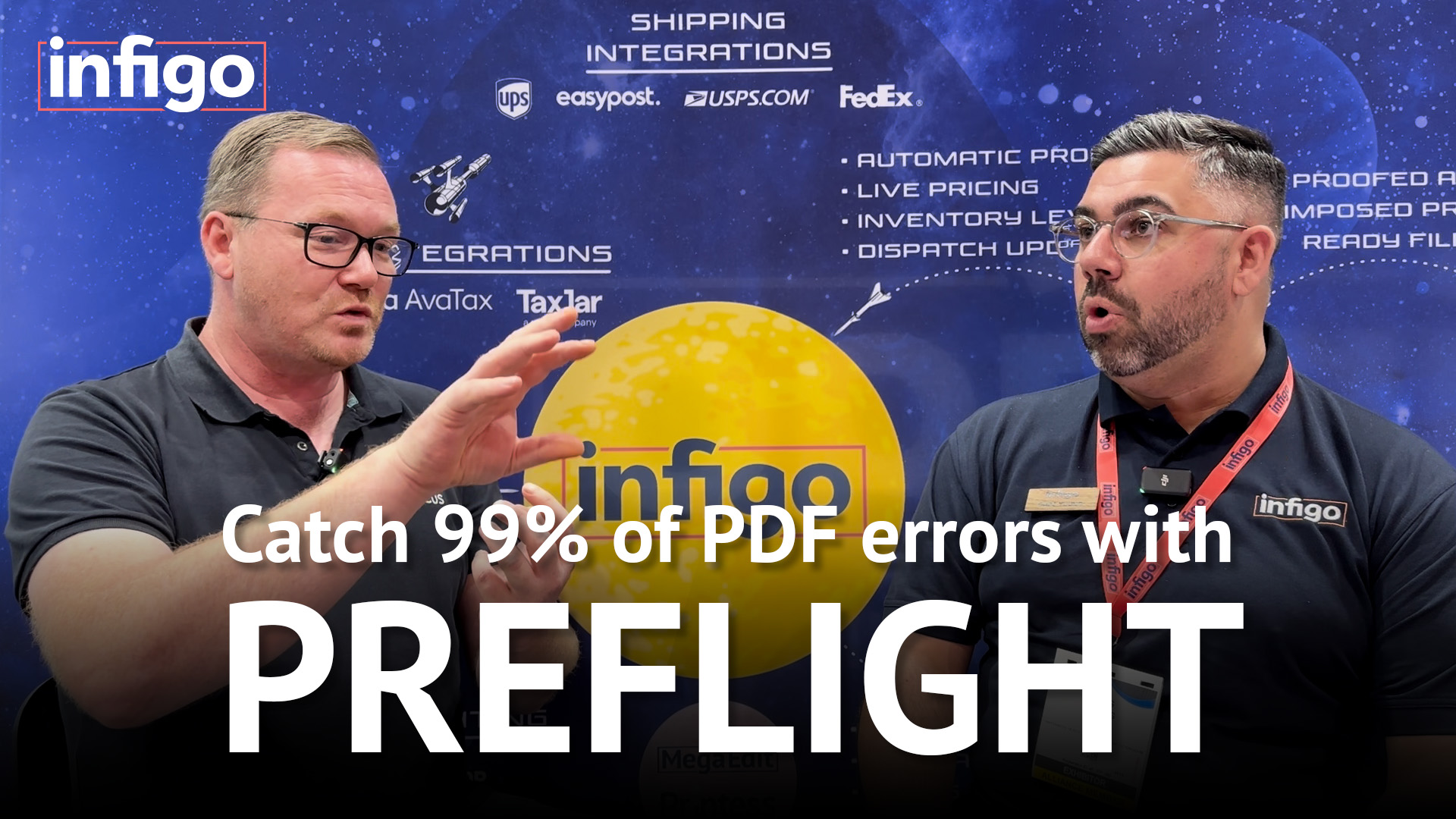
As Davy explained in this conversation, preflight automation with Enfocus PitStop eliminates 99% of PDF issues before they reach production. This isn’t just one capability among many – it’s the foundation that successful Print Service Providers build their entire automation strategy on.


Before you can automate workflows, integrate systems, or optimize production, your files need to be print-ready. Manual preflight checks create bottlenecks, allow errors to slip through, and waste valuable operator time on repetitive tasks. The Infigo-Enfocus integration solves this at the source by catching errors at upload rather than at production.


Quality control automation is Capability #1 in our proven framework that helps PSPs maintain margins despite rising costs. Discover the complete five-capability path that successful print businesses follow.


Explore the 5 Capabilities to Maintain Margins

About Enfocus

Enfocus is a Belgium-based software company with over 31 years of experience in PDF preflight, editing, and workflow automation. Their flagship products, PitStop Pro and Switch, are used by commercial printers, packaging companies, and label manufacturers worldwide to ensure print-ready files and automate production workflows.

About Infigo

Infigo provides web-to-print automation solutions for Print Service Providers, helping them streamline order capture, file preparation, and production workflows. The Infigo platform integrates with leading print industry technologies, including Enfocus PitStop, to deliver seamless end-to-end automation.

Latest posts

Ready to get started?
Find out how to scale your business with web-to-print in a tailored 1-to-1 demo
Book a demo
book a demo