Commercial printing challenges are more complex than ever. From tighter margins and labour shortages to rising customer expectations and rapid AI innovation, today’s print businesses face unprecedented pressure.
But while these commercial printing challenges are very real, they can be overcome. Many printers are already turning these pressures into opportunities by embracing automation, integration, and customer-first experiences.
This article is written by Infigo. A web-to-print software platform used by commercial printers worldwide to automate storefronts, connect workflows, and scale production. We look at the five challenges most commonly raised by our customers and prospects in 2026, and the practical steps printers are taking to address them.
We examine how print workflow automation, powered by AI and web-to-print technology, is enabling printers to simplify workflows, improve margins, and future-proof their businesses.
KEY TAKEAWAYS
- Commercial printers in 2026 face five core pressures: rising customer expectations, shrinking margins, labour shortages, disconnected systems, and keeping up with AI.
- Each challenge has a practical solution rooted in print workflow automation and web-to-print technology.
- Printers who automate repetitive tasks, integrate their systems, and adopt flexible platforms are pulling ahead of those who don’t.
- Over half of printers have achieved partial automation. Only 2% are fully automated. The gap is an opportunity.
1. Rising Customer Expectations in Print and the Demand for Instant Service
Today’s customers want everything faster and easier, and print is no exception. Whether ordering business cards, brochures, packaging or signage, buyers expect seamless, Amazon-like experiences: real-time quotes, 24/7 access, fast turnarounds, and self-serve portals.
But many printers are still relying on outdated methods: manual quoting, email-based proofing, and back-and-forth approvals. Processes that should take minutes now creep into days.
This friction doesn’t just frustrate customers. It risks losing them entirely.
That’s because, according to a Gartner Sales Survey, 83% of B2B buyers prefer ordering or paying through digital commerce
The Solution: Web-to-print portals. A branded, intuitive online storefront allows customers to customize products, get instant pricing, upload artwork, and approve proofs; all without human intervention.
That’s more convenience for your customers, and less admin for your team.
The leading web-to-print platforms are purpose-built for exactly this, transforming customer experience while freeing up internal resources for higher-value tasks.
However, many printers are struggling to modernize and automate.
According to a study by WhatTheyThink (Production Workflow in a Modern World: Making the Most of Technology), over half (51%) of respondents had mostly integrated automation, but only 2% were fully automated.
2. Shrinking Margins and Price Pressure
Overcapacity, price wars, rising material costs, and the continued commoditisation of print have squeezed profit margins across the board.
The market is saturated, customers expect lower prices and quicker turnarounds, and many commercial printers find themselves competing primarily on cost rather than value.
Competing on price alone is no longer sustainable. Even the most established printers are feeling the pinch as paper, energy, and labour costs rise faster than their ability to pass those costs on to clients.
At the same time, inefficient internal processes continue to silently erode what little profit remains.
Every additional touchpoint adds administrative overhead. Every manual process increases the risk of error, rework, or wasted materials. Over time, these inefficiencies can make even high-volume orders barely profitable.
According to Keypoint Intelligence, commercial printers lose an average of 15–20% of potential profit each year due to workflow inefficiencies, redundant processes, and lack of automation.
That’s a significant margin that could be recovered simply by improving how jobs flow through the business.
To protect profitability and remain competitive, print providers must shift their focus from cost-cutting to operational efficiency.
By optimising workflows, integrating systems, and automating repetitive tasks, printers can do more with the same resources. The result: increased throughput, improved accuracy, and enhanced customer experience.
Efficiency is no longer just a productivity metric. It’s a profit strategy.
The Solution: Automating repetitive tasks through integrated systems.
With a web-to-print solution connected directly to your MIS (Management Information System) and production workflow, you eliminate duplication and reduce errors. You process more jobs in less time, without adding headcount.
This scalability is key to staying profitable in a price-driven market. With the leading web-to-print platform, printers can automate module by module at their own pace, choosing the features and integrations that make sense for their business.
3. Labour Shortages and Skills Gaps
The print workforce is ageing. At the same time, attracting younger, tech-savvy talent into the industry is proving difficult. Many commercial printers are struggling to fill roles in prepress, production, and admin, and that’s putting further strain on already stretched teams.
According to PrintWeek, 79% of printers believe a lot more needs to be done in attracting new talent to the print industry.
Without the right people in place, it becomes harder to deliver consistent quality, meet deadlines, or scale production.
The Solution: Smart automation. By simplifying job submission, artwork handling, and proofing workflows, commercial printers can achieve more with fewer hands. Automation doesn’t just save time. It reduces reliance on hard-to-replace skills.
The most innovative platforms are designed to be intuitive and easy to adopt, meaning teams can quickly take ownership of new processes regardless of their technical experience. And the latest evidence shows that innovative technology can not only transform your workflow, it can attract the new generation of printers.
It’s important to choose a provider that offers comprehensive support. Infigo’s Academy provides live onboarding sessions, in-depth videos, and technical guidance, to ensure your team gets the most from web-to-print regardless of their starting point.
Having the right tools and knowing how to use them has helped many companies not just survive the talent crunch, but become more productive than ever before.
4. Disconnected Systems and Workflow Inefficiencies
It’s a familiar story: a customer places an order via email. It’s manually quoted, then keyed into the MIS, re-entered into prepress software, and tracked in a spreadsheet. The result: delays, errors, and mounting frustration on both sides.
Running multiple standalone platforms for CRM, estimating, production, approvals, payment, and dispatch may feel manageable in isolation. But together, they create silos that slow down the entire operation.
Information lives in different places. Teams rely on inconsistent data. Valuable time is lost chasing updates or re-keying details that should flow automatically.
This fragmented approach reduces productivity and makes it harder to scale. As order volumes increase, the lack of integration becomes a bottleneck, preventing printers from delivering faster, more responsive service.
According to Canon, businesses that optimize information workflows can reduce operational costs by up to 30%.
The Solution: Print MIS integration.
Connecting your existing systems into a single, cohesive workflow removes duplication, streamlines communication, and enables real-time visibility across departments.
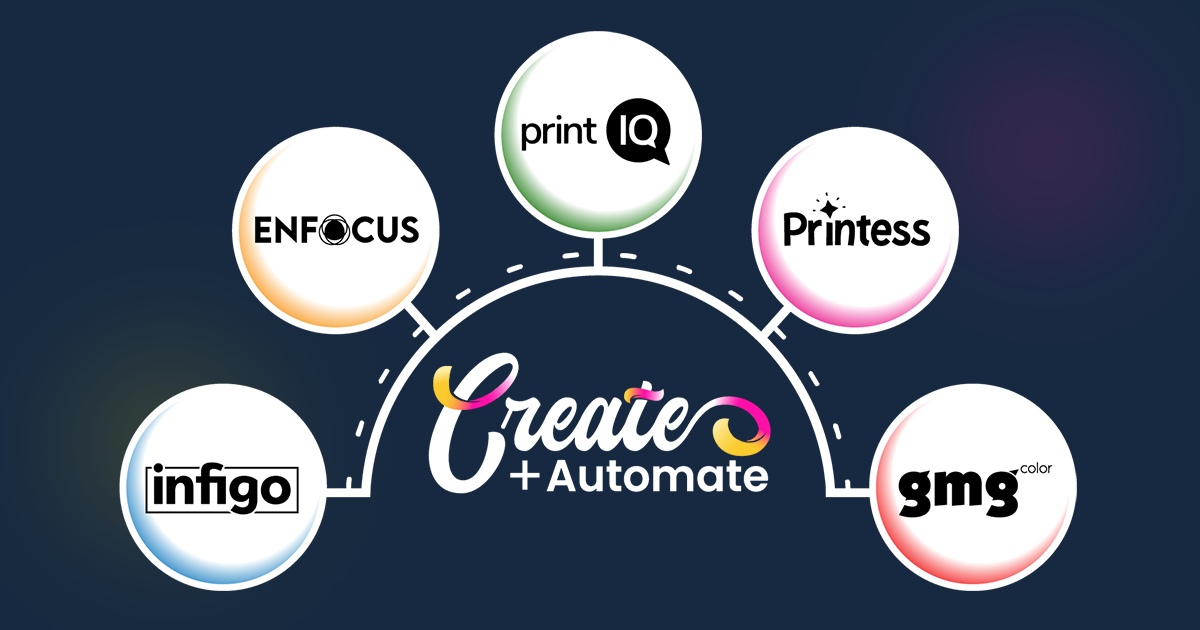
Infigo integrates with leading print MIS platforms (including printIQ and Tharstern), prepress automation tools, CRMs, and payment gateways, creating a seamless digital ecosystem tailored to your needs.
The result is a more efficient operation, faster turnaround, fewer errors, and ultimately, a better customer experience.
5. Keeping Up with Technology and AI Advancements
Artificial intelligence, predictive automation, dynamic pricing: these aren’t futuristic ideas. They’re reshaping how customers interact, how production is scheduled, and how businesses compete.
Across the workflow, leading printers are harnessing AI for:
- Automated Artwork Preflighting & Correction – AI-powered prepress tools can detect and fix common artwork issues (low resolution, missing fonts, incorrect bleed) in real-time, reducing manual intervention and preventing costly production errors.
- Smart Job Routing & Scheduling – Machine learning algorithms analyse job specs, press availability, and deadlines to automatically route work to the most efficient production path, optimising capacity and reducing turnaround times.
- Predictive Maintenance for Print Equipment – AI monitors press performance and sensor data to predict when maintenance is needed, helping avoid unplanned downtime and extend equipment life.
- Dynamic Pricing & Quoting Engines – AI-enhanced quoting systems can adjust pricing based on order complexity, customer history, material costs, and real-time capacity, delivering more accurate, profitable quotes at speed.
- AI-Powered Customer Support & Chatbots – AI-driven tools provide instant answers to common customer queries, guide users through product configurations, and capture new orders, improving service while reducing support load
According to Mckinsey, 92% of businesses intend to invest in AI in the next three years.
But for many printers, it’s hard to know where to start. The risk of investing in the wrong solution, or disrupting workflows, often leads to inaction.
The Solution: Adopt future-ready platforms that evolve with you.
You don’t need to overhaul everything overnight. Look for solutions that are modular, scalable, and built with continuous innovation in mind.
We suggest working with a web-to-print provider that treats the relationship as a partnership, one that works alongside you to prioritise the quick wins where AI and automation can create the strongest ROI.
Whether it’s dynamic templates, smart product builders, or advanced integrations our platform is built to help you grow into the future.

Overcoming Commercial Printing Challenges: From Surviving to Thriving
The challenges commercial printers face today are real, but they also signal an opportunity to evolve.
Rising customer expectations, shrinking margins, labour shortages, disconnected systems, and rapid technology changes don’t have to be threats. With the right tools, they become opportunities for growth, improved efficiency, and competitive advantage.
Infigo is a web-to-print software platform trusted by commercial printers worldwide. We help print businesses take the first step toward a more efficient, profitable, and connected operation, simplifying the journey to digital transformation at a pace that works for you. See how we’ve done it for businesses like yours.