Stop Quoting Print Jobs Blind: Fireside Chat on MIS & Profitability with Craig Powell

Posted on

Key Takeaways

  • printIQ’s quoting intelligence evaluates multiple production paths simultaneously, returning the most cost-effective option while remembering every alternative. What Craig calls the “Christmas morning moment” for print shops seeing it for the first time
  • The Infigo-printIQ partnership, now in its sixth year with nearly 50 mutual customers, has evolved from a basic iframe editor into one of printIQ’s most deeply integrated web-to-print connections
  • printIQ is built to handle labels, wide format, commercial. All in a single system, removing the need for siloed MIS platforms
  • Both Infigo and printIQ take a consultative approach to implementation, drawing on experience from 42 active joint installs to guide customers down the right path from the start
  • Profitability is the key KPI, and it starts with getting the quote right, then tracking whether actual production matches that estimate over time
  • printIQ’s open API framework is positioning the platform as a source of truth for AI-powered tools, enabling customers to bolt on chatbots and intelligent solutions backed by real production data

A Fireside Chat with Craig Powell

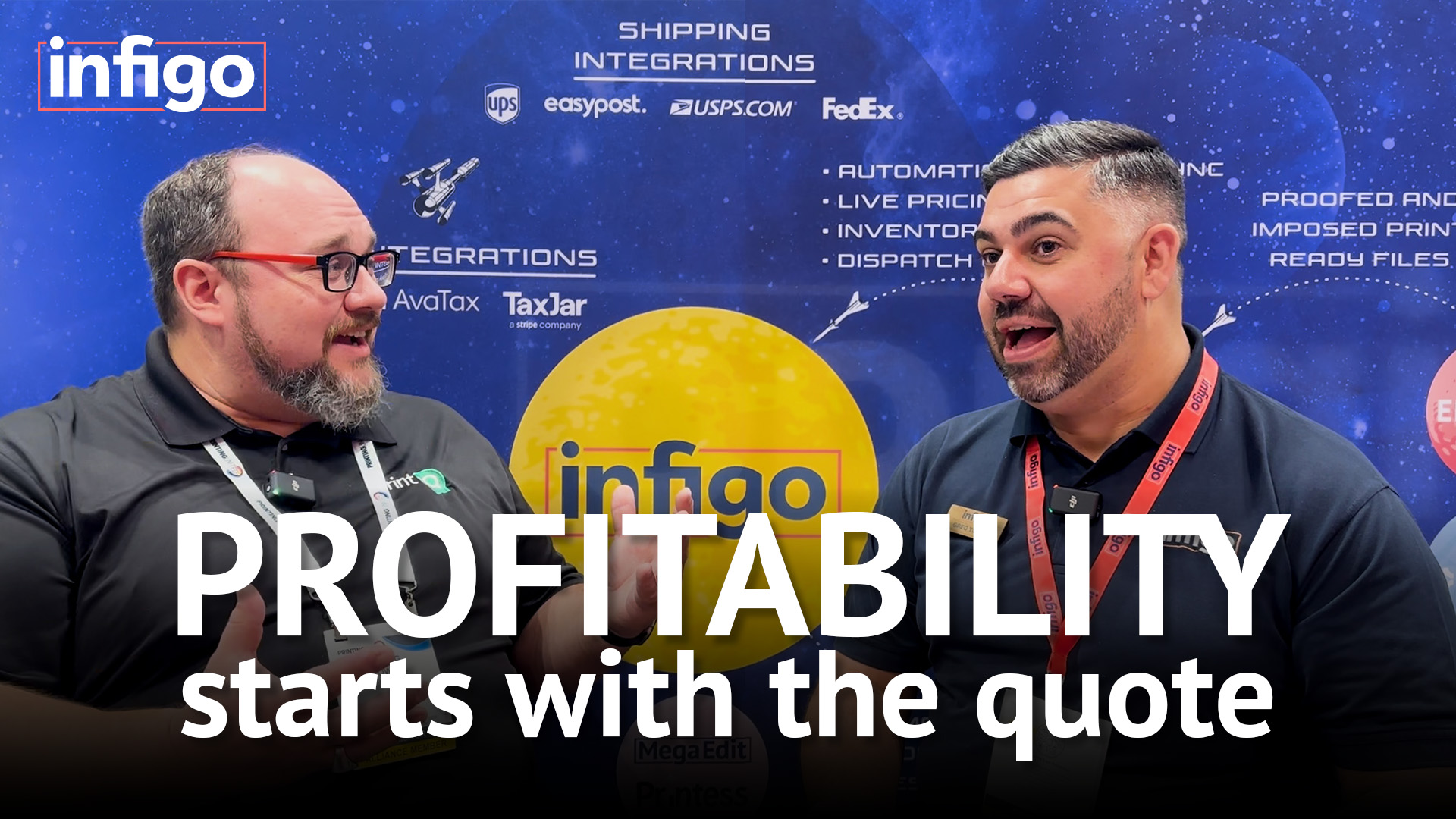
We sat down with Craig Powell at last year’s Printing United for a conversation about MIS profitability, quoting intelligence, and the Infigo-printIQ partnership. Craig serves as the General Manager of the North American region at printIQ, the cloud-based MIS platform used by Print Service Providers across North America, the UK, Australia, and New Zealand. With nearly 50 mutual customers and a partnership now in its sixth year, we explored what makes the integration work, how printIQ differentiates in the MIS market, and why profitability starts with the quote.


Meet Craig Powell & the Infigo-printIQ Partnership

Greg Young, Head of Customer Experience at Infigo:
Hello and welcome to day two of the fireside chats at Printing United 2025. Today I’m joined with Craig Powell from printIQ. Craig, welcome. Would you like to introduce yourself? Who are you? What do you do?


Craig Powell, General Manager – North America at printIQ:
Absolutely. I am Craig Powell. I’m the General Manager for printIQ in North America. So I oversee the sales team as well as operations and everything from implementation projects all the way through to go live.


Greg Young:
So a very busy role. We’ll dive into that a bit more in a minute. But first of all, I just want to kind of set the scene for the viewers on how our partnership came about and how it’s developed. So Infigo and printIQ, we’ve worked together, I think we’re now into year six. It was 2019 when we first launched the initiative, mainly in the Australia and New Zealand market, and I was lucky enough to travel up to Sydney for a launch event. And we initially were just looking at iframing our technology within your platform to give a fairly basic offering using our editor with your capabilities directly in the product.


And now here we are today with nearly 50 mutual customers that go from that small implementation up to some of our probably largest customers together, utilising and enhancing the partnership. The partnership obviously continues to go from strength to strength. And customers are reaping the rewards, which is absolutely what we both want.

Craig's Role at printIQ

Greg Young:
So, tell me a bit more about your role, Craig. You mentioned about the sales, operations, onboarding, project management side of things. That’s already quite a lot, but what does the day to day look like for you?


Craig Powell:
Yeah, the biggest thing is I don’t do all that alone. We’ve got an amazing team across all those different areas of the business. So I get to just coordinate working with all of those great teams to tackle all the different aspects of what’s going on. It really makes sense for us to do it that way because it’s a streamlined operation where we’re uncovering and having really great conversations at the pre-sales side, and then that translates in a nice, coordinated handoff to implementations where we assign project managers and build leads to help guide the customer through that implementation process.


And then we’ve beefed up the support we give after they go live as well. So we’re there to continue to make sure that it’s optimised and working for their business as they need it, even afterwards. And it really pays off because we’ve got a great track record now where we’ve had people in the system for many, many years. Starting in New Zealand, and then Australia. We’ve had people now for more than a decade that have been using us. And now having been almost nine years in the US market, we’ve got customers that have been with us here almost a decade now, right? So it just goes to show you that it’s a true partnership and not just another piece of software.

What Makes This Partnership Work?

Greg Young:
I think that’s one of the big things we’ve been talking about a lot at the event, and something we talk about a lot outside of these events. Our partnership network. We’ve always realised that the way we can help our customers grow more is to be very selective of the partners that we work with, making sure we choose the best in class. And from day one of our partnership with printIQ, we’ve just seen our customers see success straight away. I often explain our partnership to either existing customers or prospective customers, that there’s so much synergy between our businesses. Both cloud-based technologies, both in very similar markets, geographically as well as the individual verticals within the industry. It definitely helps us because we’ve still got that same mindset. Do you see that from your side?


Craig Powell:
It’s absolutely true. It’s a little bit of a mixed bag, right, working with integrations. And obviously some you’ve got more experience than others with. But when you have a longstanding partnership, and truly a partnership, because the best thing is, it’s not something where we went off and cooked up a way to integrate with you without ever talking to you, and vice versa. We’ve coordinated over time now to strengthen it to where it’s one of the most integrated web-to-print connections that we have. And it’s actually influenced us building directly into our platform hooks and functionality specifically for Infigo. And that only happened by coordinating between our dev teams. And ultimately that grew out of listening to what customers want, really, at the end of the day.


Greg Young:
And I think that’s it. Our customers have all got that right mindset. Erich Schlarb was on the stand here a minute ago. Erich from Voom Group. He, as the owner, just had the right mindset of what he wanted to achieve with the technology. And he kind of broke it down into the whole flow and said “This is my storefront piece, I’ve already got printIQ, so what does that look like in terms of a transfer of data?” And then “how do I make that more efficient?” “How do the CSRs utilise that?” “Are they going to printIQ?” “Are they going to Infigo?” And just broke that whole journey down. It’s amazing as a case study to see the success of someone that isn’t a big shop, hasn’t got teams of hundreds of developers behind them, but had the tenacity and the vision to actually deliver. I think that’s kudos to both our platforms and how agile they are that you can fit into that box.


Craig Powell:
Absolutely. The functionality is there to achieve those different use cases. You’ve got that ability to have the confidence to know that on both sides of the fence, as we interact with each other, it’s going to work. But again, just speaking to the partnership. Customers, when they are going through an implementation of one platform, it’s a whole lot of work. But when you’ve got two platforms, and in some cases they’re doing multiples in different parts of the workflow. Sometimes we hear horror stories about where they get into that and they’re left to try to figure it out on their own. Those two different integrations aren’t talking to one another, human to human and team to team, they’re not talking to one another.


I think that’s one of the key differences, where we know that we’re talking about it, knowing what we need to coordinate on, having those meetings between our teams along with the customer, but also separately to make sure we understand what each other needs to do. And that just really speaks to smoothing over that process so we can both deliver a mutual experience that’s better for the customer.

Guiding Customers Down the Right Path

Greg Young:
And ultimately we’ve got,  I think we’re at 42 active installs between us, people using the storefront connected to printIQ. As we do more and more of that, the process is going to get slicker and slicker. Every time we see it from our side, it gets quicker and easier because we share all learnings from past implementations and are now more versed and educated in how we can push people down the correct path. Something we do is we’ve learned to have the confidence to tell people they might be going down the wrong path. Is that something you guys would also advise on? Like, “we’ve got past experience of this”, “maybe you’d be better looking at this route instead?”


Craig Powell:
Absolutely. I think over time, as you gain the track record and experience, customers come to you also for guidance. It turns into more of “They’re not just hiring us to do a thing. They’re hiring us to be a consultant.” To actually help say, based on what you’ve done for other people, what you’ve seen in the industry, what people are looking for. They’re asking for that guidance.
Sometimes people come in, they have a very singular vision. They know exactly what they want. And obviously we can deliver on that as well. But for those that don’t have all the questions answered, I think it turns into a consultative relationship where you’re able to do that. And I absolutely would echo that. We classify integrations as we do them with partners kind of in different ways, really based on how often have we done it, what’s our confidence level around knowing what the product is on that side. And Infigo being the status that it is now. As far as we’re concerned, we know we don’t need to add a bunch of extra time to figure stuff out, because we’ve already sorted that out. There’s a confidence there.


Greg Young:
I had a conversation with someone yesterday that already uses your platform and are looking at ours now. They were talking about the integration. Asking, “am I going to have to use a developer?” And I was like, well actually the user interface is built out now from the configuration side. We’re connecting to you guys (printIQ), you’re still the source of truth, but we are connecting to you to pull the data into our platform. You don’t have to go write code. You don’t have to go and write a script. It is through a user interface now. And we only want to improve that more so that as people onboard new customers and build out new storefronts or new products, that’s going to be even more simplified.


And one of our big mutual UK customers. One of the big things from them was they had 150 storefronts with thousands of products, and we developed the capability of being able to sync products live from your platform and generate them automatically in our platform without having to get a developer involved. And the power of that kind of thing: we’re looking at efficiency, we’re looking at automation, but ultimately we’re saving time.

printIQ's Global Structure

Greg Young:
I’m gonna go back up a step. Obviously you’re General Manager of North America. Tell us a bit more about the makeup of the business. What does that look like around the world? Because obviously you’re regionalised.


Craig Powell:
Yeah. It used to be different. A couple of years ago, we went through a restructuring just to try to align what made sense for us on how we run the business, but also ultimately with the customer in mind. And part of that restructuring led to the regional structure where there’s a general manager, like in my case in North America. We have a general manager in the UK, and then we have one in Australia, New Zealand. We still collectively work together as an executive team, along with our CEO and some other key people on that executive team.


But we try to build every region where we’ve got resources in region to support customers inside that region as much as possible. So there’s some shared services, we have a common development team that physically sits over in New Zealand, and we share those services. But for the most part, we’ve got everybody on staff here. Our team is able to roll out and deliver for customers everything that’s needed, right here in North America. And the same being true for those other regions. So it’s really having the autonomy where we need it, but also having the shared support where we need it as a global company.

What Makes printIQ Different?

Greg Young:
So, why would you say that printIQ is different to other MIS platforms in the market?


Craig Powell:
First and foremost, we never have been kind of put into one type of development for one type of printing. There’s some MIS platforms out there where maybe they only do labels or they only do wide format or whatever. Over time, the strength and versatility of our platform means that we’ve got customers who have a mixture of all different types of printing. And they’re looking for a platform that allows them to put all of that into one. So you can mix and match and co-mingle all of that type of work. You don’t want to work in silos of different platforms, you want to have one cohesive system. So I think that’s a differentiator.


But I’d say beyond that, the complexities of how we’re able to layer in automation in different ways, whether that be our quoting intelligence, which is really what sets us apart. This is something that’s really cool, especially at trade shows, because when we give demos for people, we see it. I call it the Christmas morning moment, where their face lights up with, “oh my gosh, where has this been all my life?” And they really see it because not only are you going in to get one quote, but actually because the operations and the equipment and the people, all of the process that goes into what you need to produce a job in your shop. We have all of the context of that. We have the neural pathways, as it were, of what all that looks like. So when you do an estimate, it’s actually doing multiple estimates all at the same time. It comes back to you with the most cost-effective way, but it remembers all of those different estimate paths. So in one click you could switch to a different path if you wanted to. And most people are like, mind-blowing for them.


And then I’d say the third part of it is integrations. Our API framework is the most open and powerful among the MIS market, where we’ve got all kinds of integrations upstream, downstream in the workflow. And it’s so powerful, and the access that we give to it is so powerful. We even have customers that have gone off and done their own integrations that we didn’t officially do. And they were only able to do it because of that access that we give.


Greg Young:
I think there’s a fourth thing you’re missing. You’ve got the best-looking MIS on the market as well.


Craig Powell:
Well, there you go. I don’t want to brag, but I’ll take it that you said that.

Data-Led Decision Making & AI at printIQ

Greg Young:
No, it’s true. I think a lot of people’s perception is that MIS platforms are very technical focused platforms, and some products on the market almost look just like a database that doesn’t have much of a user interface. That’s one thing that really surprised me when I first started working with you guys in 2019 was the front end of it essentially was anyone could pick this up. You don’t have to understand all the technical side of things, it’s all handled behind the scenes. And that’s something that we hear from our users as well, just saying, we can pick this thing up so quickly and easily, we can onboard new staff and they can just get it.


I was at Arizona State University last year. They were going through the onboarding with yourselves, they’ve been a long-time Infigo customer. They were showing me all of their iPads, on every device that they’ve got, with printIQ running, and they’re like, this is just amazing visibility that we’ve now got at machine level and potentially operator level as well, that we are now tracking data far greater than we ever had before.


And we just had one of your customers on the stand a second ago, and they were telling me that from the MIS they moved from and onto your platform, after they’d been live for three months, something that used to be a weekly task, they now do quarterly, just as peace of mind, just as a sanity check. And actually, they know they can trust the system and the data is correct. In this data-driven world, it’s so important. You’ve got to trust what the platform’s doing.


Craig Powell:
And on the data side too, I can’t stress it enough just based on my own experience being in the industry on both sides of the fence, but also talking with people all the time. You put a ton of data into these platforms. And it’s really key to make sure you also have a partner that you can get that data back out, in an actionable way. Because what good does it do you if you can’t get it out?


So through things like integrations, through things like reporting, which is another robust area for printIQ, the ability to write custom reports and really deep dive into the analysis of how your business is doing. That really just transforms it. So it’s not just going into a black box that you’re not able to ever get anything out of.


Greg Young:
How does that work. Do you try a consultative approach to push people into that data-led mindset?


Craig Powell:
Absolutely. It’s a mixture. People are at different parts of their journey in their business from an automation and data standpoint. A lot of people are either doing some form of it but they want to do more, or they’ve really pushed it hard and it’s a requirement that if they’re going to move to a platform, they’ve got to make sure they have that same amount or better of what they’re able to do.


But yeah, it definitely turns into a consultative approach where we give power for them to be able to write their own queries and custom reports and all that. But we also have people on staff that can dive in and help figure out what reports are needed. We can support it from both sides.


Greg Young:
Fairly similar to ourselves. We’ve got a module called Insights. Every customer’s got access to it, but we’ve got different versions depending on how deep you want to get. Some customers will run with it because they’ve got the mindset or they’ve got a developer on staff and can write the SQL. Other customers just want to use us and a professional services team. They’ve got an idea, but just don’t know how to get there. You guys are so similar in that setup as well.


Craig Powell:
And it’s exciting as well, because we’re in the middle of a migration over to Microsoft Power BI for reporting. That’s even more exciting because being a Microsoft product, co-mingling Copilot inside of there gives you the ability for pushing all of this data right into the Power BI model coming out of printIQ. And then you have the ability not only to write reports and run them as you always have with graphs and everything else, but potentially have an AI assistant to help you analyse that data and make some actionable suggestions or decisions about how things are going.


Greg Young:
That wasn’t going to be one of my questions, but I’m going to go into it. So what does AI look like at printIQ?


Craig Powell:
We’ve been having this discussion a whole lot as of late, as most people have. And it’s really two-fold. There’s some internal stuff obviously. As most companies are, we’re using AI in different ways inside the business from a development standpoint, to help analyse code and improve on that process, to some generative AI for purposes inside the business.


But we’re harnessing it in a couple of ways. One of them is the ability to create a chatbot that uses that core AI knowledge that it already has, but then layering in some fine-tuned training on top of that, so that we’ve got knowledge base, and answers to support tickets. All of that goes in there to help give a way for people to get some tier one type support.


But then the other part really is the integrations play. We see ourselves in this space as we always have been. You said source of truth earlier. That’s true. We continue to be that source of truth. And just like we do with web-to-print integrations, like with Infigo, external systems can potentially call out to printIQ to get the information that’s needed. A lot of customers are starting to look at that same concept of building some kind of conversational chatbot. But you want to make sure that chatbot doesn’t just go off and make something up.


Greg Young:
It’s got to be accurate.


Craig Powell:
It has to tie back to some source of truth in this particular case. Our robust API framework will allow for us to identify APIs we already have, webhooks we already have, and others we may develop in the future to enable you to bolt on these smart and cool AI solutions that are coming, to that core framework that you’re already building with printIQ.


Greg Young:
It’s so interesting. It’s at the forefront of everyone’s conversation at the moment. There’s an AI pavilion here at Printing United. It’s going to be interesting to see how much it evolves because how much it’s evolved in the last 12 months is quite frightening and very exciting. Platforms like ours. We’ve just got to make sure we keep pushing ahead. At the moment we’re mainly using internal processes and service-driven stuff, but it’s how we then continue to bring that into our product. I’m excited to see what we can both do together on that.

Unlocking Benefits & Measuring ROI

Greg Young:
So, for printers exploring our platforms together for the first time. What’s the easiest way, do you believe, for them to unlock some immediate benefits?


Craig Powell:
For our solutions together, I think speaking like we were earlier about that use case of what they’re trying to achieve, because of the track record we have mutually, and we’ve got a lot of really great examples of customers that we’ve rolled out solutions for. It makes it easy where we’re maybe not reinventing the wheel. It’s just deciding how to get where we need to go for what someone’s looking for.


Having the ability for them to define that, what that looks like, that may be a conversation that you have with them, but also we’ll probably be brought in to that if we’re already their MIS. Or if they don’t have an MIS and they’re looking to make a switch, we can show them the way forward on how we could partner together to make that switch happen.


And then in the pure MIS side of it, we’ve always been about starting with a quote, getting that right from the very beginning, because getting a quote for how that job is going to flow through the shop is the best way to ensure that you’ve got the automation able to happen downstream. You’ve got everything defined as it needs to be. And through stuff built natively inside of there, the ability to track a job all the way from quote through to production, job ticketing, inventory, all of that inside the system, all the way through to shipping and getting an invoice out within the same system. There’s a lot of native capabilities in there that are further enhanced by other integrations.


Greg Young:
Final question. Are there any specific KPIs or metrics that you are looking at or advising customers to look at at the early stages so they can start to validate early-stage benefits. Or return on investment?


Craig Powell:
There’s all a mixture of KPIs that people have. But I’d say one of the most common ones that everyone’s always looking for in any business is “How profitable are we?” And the best way to do that is to make sure that when you’re estimating, what is the actual reality of that production? What does that look like? At the end of it all, did it perform like we thought it would? Because over time, you need to always be mindful of that so you can tweak it.


We want to give actionable data inside the system so that they can track that. It helps inform them what they need to do to continue honing in on what that looks like. The cool thing is with automation, whether that be AI or the automation that’s existed already, the print industry for a long time has been looking not to replace people, but to work smarter and to do more with less people. There’s not always new blood coming into the industry. So we’re all looking for ways. You know, we’re wearing multiple hats, most people are in their roles inside their business. So that profitability play, having systems and tools in place that allow you to uncover what that is and help automate a way to get there is really the key KPI that most people are looking for.

About Infigo

Infigo provides web-to-print automation solutions for Print Service Providers, helping them streamline order capture, file preparation, and production workflows. The Infigo platform integrates with leading print industry technologies, including Enfocus PitStop, to deliver seamless end-to-end automation.

Latest posts

Ready to get started?
Find out how to scale your business with web-to-print in a tailored 1-to-1 demo
Book a demo
book a demo